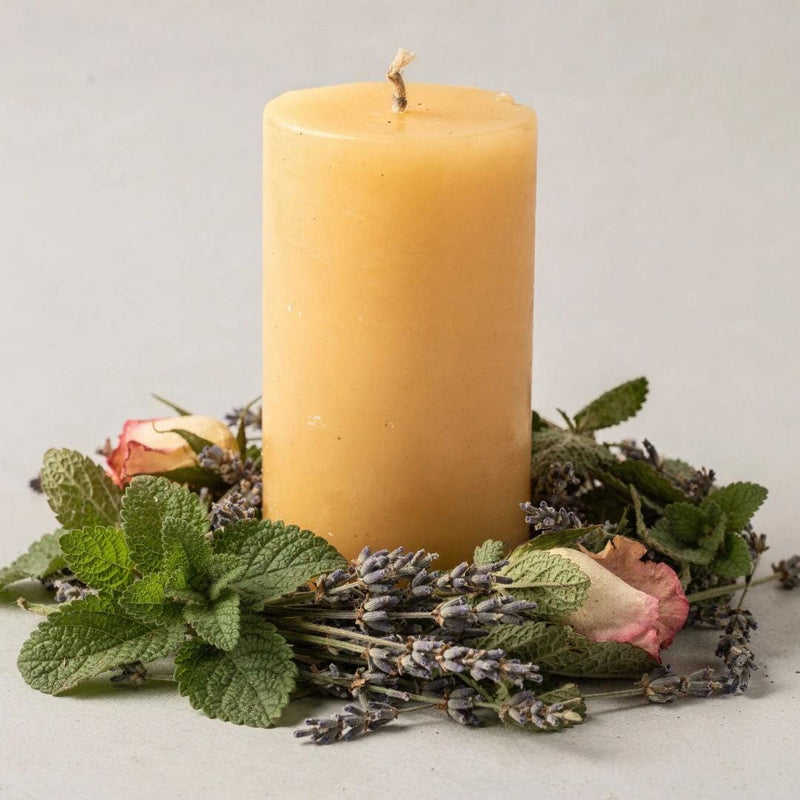
Tender Heart
Self-Compassion, Emotional Healing, Self-Love
Infused with Real Herbs
 Lavender
+
Lavender
+
 Lemon Balm
+
Lemon Balm
+
 Rose
Rose
Scent: A harmonious blend: Floral, calming, slightly sweet with herbaceous depth; Bright citrus-mint, uplifting and fresh; Sweet, romantic floral with honey undertones
View Size GuideSelect Size
Your payment information is processed securely. We do not store credit card details nor have access to your credit card information.
Inner Radiance: Learning to Love Yourself First
This self-love candle creates gentle space for the hardest work-learning to truly love yourself. Our hand-poured beeswax blend of rose, lemon balm, and lavender isn't magic that suddenly makes you love yourself-it's more like creating a gentle space where that work becomes a little easier. Think of it as the aromatic equivalent of a friend giving you a hug when you're being too hard on yourself.
What These Flowers Mean:
Rose shows up everywhere when people talk about love-Venus, Aphrodite, Mary, pretty much every divine feminine figure you can think of. The message is universal: love itself is sacred, and that absolutely includes loving yourself. Medieval monks grew lemon balm in their gardens specifically for "gladdening the heart"-literally, that's what they wrote in their herbals. And lavender? It's been blessed and burned in temples, homes, and healing spaces for as long as anyone can remember. Together, these three plants are basically a gentle reminder that you deserve kindness.
How to Work With It:
This blend supports all the hard self-love practices-mirror work, affirmations, inner child healing, all of it. Light it when you're doing heart chakra meditations or when you just need to sit with your feelings without judgment. Some people write affirmations on paper and burn them in the flame as a way of releasing old shame and choosing to believe something new. This candle holds space for tears, for transformation, for the messy work of believing you're enough exactly as you are.
Why These Scents Matter:
Rose, lemon balm, and lavender have been favorites in aromatherapy for creating spaces that feel emotionally safe. Rose's sweet floral scent is associated with comfort and love in traditions around the world. Lemon balm's gentle citrus-herb smell has traditionally been used to lift heavy moods-those monks were onto something. And lavender is probably the most widely used calming herb in aromatherapy history. Together? They create an atmosphere that just feels like a gentle exhale.
The Three-Part Infusion Process:
Here's where it gets complicated: rose petals, lemon balm leaves, and lavender flowers all have completely different infusion requirements. Rose is incredibly delicate-too much heat and you lose its subtle sweetness entirely. Lemon balm's mood-lifting compounds are volatile and evaporate easily. Lavender can turn harsh and medicinal if the temperature isn't just right.
So we infuse each herb separately into its own batch of beeswax, spending hours with each one to get it perfect. This isn't just about different temperatures-if we tried to infuse all three at once, the stronger herbs would overrun the mixture and fight for space in the wax. Rose is delicate and would get completely crowded out by the more aggressive lavender. By infusing separately, each plant gets its full time to transfer into the wax without competition. Then we blend the three infused waxes together. It's triple the work, but it means you actually get all three plants fully present and balanced instead of whatever herb is most dominant. The result smells-and feels-like kindness itself.
What You're Getting:
- Hand-poured beeswax candle (size varies by option selected)
- Real rose petals, lemon balm, and lavender infused directly into the wax
- Each herb infused separately, then blended
- Hemp wick for clean burning
- Metallic wick anchor
- Container included if jar option selected
- Affirmation: "I am worthy of love exactly as I am"
These statements reflect traditional and historical use. This product is not intended to diagnose, treat, cure, or prevent any disease.
- During self-care and self-love rituals
- When healing from past wounds
- In times of depression or sadness
- When you need to be gentle with yourself
- During emotional healing work
Ritual Instructions
Light this candle when your heart is tender. These three flowers cradle broken hearts with gentleness. They teach that healing isn't forcing—it's allowing, accepting, and loving yourself through the pain.
Gentle Healer, You are close to the brokenhearted. Hold my tender heart with compassion. Heal the wounds I carry and teach me to be gentle with myself. Help me accept all my emotions as sacred. Grant me the courage to feel deeply and the wisdom to heal wisely. Restore my capacity for self-love and self-compassion. Amen.
Gentle flowers, hold my heart, Heal the wounded, broken part. Teach me softness toward my pain— Help me love myself again.
📜 Sacred & Spiritual References
The herbs in this candle have been revered across many spiritual traditions throughout history:
BIBLICAL CONNECTION (SPIKENARD/NARD): While lavender itself isn't named in Scripture, it's closely related to spikenard (nard), which appears in:
SONG OF SOLOMON 1:12: "While the king was at his table, my spikenard sent forth its fragrance."
SONG OF SOLOMON 4:13-14: "Your plants are an orchard of pomegranates with pleasant fruits, spikenard... spikenard and saffron, calamus and cinnamon."
MARK 14:3: "A woman came with an alabaster jar of very expensive perfume, made of pure nard. She broke the jar and poured the perfume on his head."
JOHN 12:3: "Mary took a pound of very costly perfume of pure nard, and anointed the feet of Jesus and wiped His feet with her hair; and the house was filled with the fragrance."
CHRISTIAN TRADITION: Medieval Christians believed lavender protected against evil. Crosses of lavender were hung over doors for protection. The plant was grown in monastery gardens.
BIBLICAL ERA: While not directly named in Scripture, lemon balm (Melissa officinalis) was cultivated in the Temple gardens of Jerusalem and used by priests.
JEWISH TRADITION: Called "heart's delight" in ancient Hebrew texts. Used to lift spirits and as a ceremonial herb during festivals.
CHRISTIAN MONASTIC TRADITION: Carmelite nuns created "Carmelite Water" from lemon balm in the 14th century, used for spiritual and physical healing. Paracelsus called it the "elixir of life."
GREEK TEMPLE TRADITION: Sacred to the Temple of Artemis at Ephesus. The name "Melissa" comes from the Greek word for honeybee, connecting it to the sacred Melissae (bee priestesses).
BIBLE - SONG OF SOLOMON 2:1: "I am the rose of Sharon, a lily of the valleys." While scholars debate the exact flower, this verse has been interpreted as referring to Christ or the beloved.
ISAIAH 35:1: "The desert shall rejoice and blossom as the rose."
CHRISTIAN TRADITION: The rose is strongly associated with the Virgin Mary - "Mary's Rose." The rosary derives its name from "rose garden." White roses symbolize Mary's purity; red roses represent Christ's blood and martyrdom.
SUFI TRADITION: The rose (gul) is central to Sufi poetry and symbolism, representing divine beauty and love. Rumi wrote extensively about the rose as a symbol of the Beloved (God).
PERSIAN/ZOROASTRIAN: Roses were sacred flowers, associated with paradise and divine beauty.

